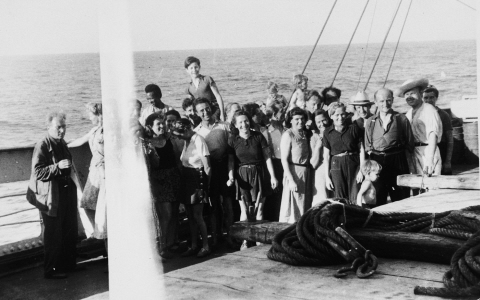
Serge (far left) and other left-wing exiles on board the ship taking them from Marseille to Martinique in 1941
The writer and revolutionary Victor Serge, born Victor Kibalchich in Belgium in 1890, may be seen as a Continental counterpart to the British author George Orwell. The child of exiled Russian revolutionaries, Serge’s political philosophy shifted repeatedly over the course of his life. Initially a socialist, he became a believer in individualist anarchism while still in his teens. Still, despite his individualist sympathies, he threw in his lot with the Bolsheviks, and fought in the Civil War. By the mid-1920's, he had become associated with Leon Trotsky’s Left Opposition. Stalin later had him arrested and sent him to exile in Soviet Central Asia, and although Serge was allowed to leave the Soviet Union in 1939, he spent the rest of his life in well-founded fear of assassination.
Throughout these years, he was turning his experiences and his political analyses into novels and non-fiction works, written in French. After France fell to the Nazis in 1940, Serge was able to make his way to Martinique, where he wrote an autobiographical roman à clef about the fall of France, the plight of the refugees, and the voyage that took him and others to the new world.
Two of his finest books were
The Case of Comrade Tulayev and
The Unforgiving Years. The former deals with the Soviet Union during the purges, as the old Oppositionists were being picked off. His
Memoirs of a Revolutionary is also a remarkable document, a portrait of an extraordinary man, taking part in extraordinary events.
Peter Crane will discuss Victor Serge’s writing and its influence on political thinkers in the middle 20
th Century, and on writers such as George Orwell, whose
Animal Farm owes much to Serge’s thinking – though where Orwell paints a dystopian vision, Serge was more hopeful.
Peter Crane, born in 1946, graduated in 1968 from Harvard College, where he studied history under the direction of Professor Peter Stansky, now emeritus professor at Stanford. He received a law degree from Duke in 1973 and spent his legal career in the U.S. Government, retiring in 1999 to devote himself to history. His account of the German-Jewish emigration from Hitler, presented primarily through original letters, was published by Weidle-Verlag in Bonn, Germany, in 2005, under the title
Wir leben nun mal auf einem Vulkan [We are Living on a Volcano]. An English-language version is nearing completion. He has also published in the Tolstoy Studies Journal and numerous newspapers. He lives in Seattle.