Monthly Archives:

Monthly Program: Exploring the Links between Tourism and War

Sunday, July 26,  2 pm: Mills College history professor emeritus and 40-year Institute member Bert Gordon presented  “Exploring the Links between Tourism and War, based on the research for Bert’s most recent book, War Tourism: Second World War France from Defeat and Occupation to the Creation of Heritage,

…

Read more ›


Harlem of the West: The Fillmore Jazz Era and Redevelopment

A lecture with Elizabeth Pepin Silva
Sunday, August 16 2020 at 2:00 PM
via Zoom

Ms. Silva is a documentary filmmaker, photographer, writer, and former day manager of the historic Fillmore Auditorium. She grew up all around the Bay Area 

…

Read more ›


California and the West Events

Fall 2020: Revealing San Francisco’s Hidden 19th-Century Black History: A Tour of California Historical Society Artifacts, lecture by Susan D. Anderson, SF History Days (video here)

Summer 2020: Harlem of the West: The Fillmore Jazz Era and Redevelopment, online lecture by Elizabeth Pepin Silva

Fall 2019: An event-filled two-day excursion to Sacramento

Fall 2019:  Tour of Marin Civic Center and presentation by member Bonnie Portnoy on The Man Beneath the Paint: Tilden Daken

Summer 2019: Reading of Judith Offer's play, Scenes from the Life of Julia Morgan

Fall 2018: Public Program, "South Asians in the South Bay: The Privileged Immigrants"

Spring 2018: Excursion to Niles area of Fremont with historic train ride and silent film museum

Spring 2018: The California and the West study group initiated the two public programs on "The Future of the Past in the Digital Age" and Benjamin Madley's talk on An American Genocide: The United States and the California Indian Catastrophe, 1846–1873.

Fall 2017: Martinez Adobe Fandango; Public Program: “Siberia and California: Connections During the Russian Revolution and Civil War”

Fall 2016: Amador County

Summer 2016: San Francisco Presidio

Winter 2016: Berkeley History Center

Spring 2015: Sonoma Plaza

Winter 2015: San Francisco Public Library

Summer 2014:  Red Oak Victory and World War II Homefront National Historic Park, Richmond

Spring 2014:  Los Gatos History Museum, "American Bohemia: The Cats Estate in Los Gatos”

Winter 2014:  Tour of California Historical Society exhibition on Juana Briones, January 25

Summer 2013:  Green Gulch Farm Zen Center visit, August 15

Spring 2013: Visits to Vallejo Naval and Historical Museum and the McCune Collection at the Vallejo Public Library, April 13

Writers Group Upcoming Meetings

Saturday, October 5, 10 am, via Zoom.

Public Programs

Sunday, August 21, 2:00 pm, Public Program via Zoom.
Writing and Revising Narrative History
A Presentation by Megan Kate Nelson
Join the Mechanics' Institute and the Institute for Historical Study for this exciting talk about writing with historian Megan Kate Nelson who left academia in 2014 to become a full-time writer. During this Zoom event, she will offer advice for writers who want to publish trade history books and other pieces for general readers. Dr. Nelson will talk about how to make the transition from academic to narrative history writing, how to revise manuscripts for trade publication, and how to pitch articles and Op-eds to newspapers and magazines.
Megan Kate Nelson is a historian and writer, with a BA from Harvard and a PhD in American Studies from the University of Iowa. She is the author of four books: Saving Yellowstone: Exploration and Preservation in Reconstruction America (Scribner 2022); The Three-Cornered War: The Union, the Confederacy, and Native Peoples in the Fight for the West (Scribner 2020; a finalist for the 2021 Pulitzer Prize in History); Ruin Nation: Destruction and the American Civil War (Georgia, 2012); and Trembling Earth: A Cultural History of the Okefenokee Swamp (Georgia, 2005). She writes about the Civil War, the U.S. West, and American culture for The New York Times, Washington Post, The Atlantic, Smithsonian Magazine, and TIME. Before leaving academia to write full-time in 2014, she taught U.S. history and American Studies at Texas Tech University, Cal State Fullerton, Harvard, and Brown. She grew up in Colorado but now lives in Boston with her husband and two cats.

Next Monthly Program

Saturday, November 21, 10:00 am, Monthly Program via Zoom.
Victor Serge, Revolutionary and Author
A presentation by Peter Crane
Serge for Crane clip_image001

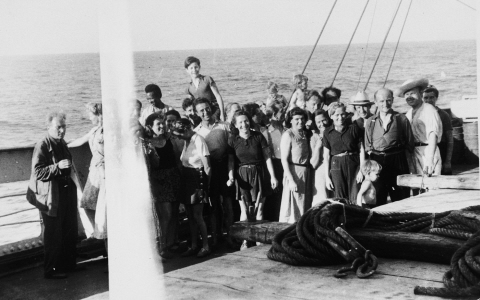
Serge (far left) and other left-wing exiles on board the ship taking them from Marseille to Martinique in 1941

The writer and revolutionary Victor Serge, born Victor Kibalchich in Belgium in 1890, may be seen as a Continental counterpart to the British author George Orwell. The child of exiled Russian revolutionaries, Serge’s political philosophy shifted repeatedly over the course of his life. Initially a socialist, he became a believer in individualist anarchism while still in his teens. Still, despite his individualist sympathies, he threw in his lot with the Bolsheviks, and fought in the Civil War. By the mid-1920's, he had become associated with Leon Trotsky’s Left Opposition. Stalin later had him arrested and sent him to exile in Soviet Central Asia, and although Serge was allowed to leave the Soviet Union in 1939, he spent the rest of his life in well-founded fear of assassination. Throughout these years, he was turning his experiences and his political analyses into novels and non-fiction works, written in French. After France fell to the Nazis in 1940, Serge was able to make his way to Martinique, where he wrote an autobiographical roman à clef about the fall of France, the plight of the refugees, and the voyage that took him and others to the new world. Two of his finest books were The Case of Comrade Tulayev and The Unforgiving Years. The former deals with the Soviet Union during the purges, as the old Oppositionists were being picked off. His Memoirs of a Revolutionary is also a remarkable document, a portrait of an extraordinary man, taking part in extraordinary events. Peter Crane will discuss Victor Serge’s writing and its influence on political thinkers in the middle 20th Century, and on writers such as George Orwell, whose Animal Farm owes much to Serge’s thinking – though where Orwell paints a dystopian vision, Serge was more hopeful. Peter Crane, born in 1946, graduated in 1968 from Harvard College, where he studied history under the direction of Professor Peter Stansky, now emeritus professor at Stanford. He received a law degree from Duke in 1973 and spent his legal career in the U.S. Government, retiring in 1999 to devote himself to history. His account of the German-Jewish emigration from Hitler, presented primarily through original letters, was published by Weidle-Verlag in Bonn, Germany, in 2005, under the title Wir leben nun mal auf einem Vulkan [We are Living on a Volcano]. An English-language version is nearing completion. He has also published in the Tolstoy Studies Journal and numerous newspapers. He lives in Seattle.
You are welcome to invite friends and colleagues to attend.
The presentation will be recorded, and posted on YouTube. If you don’t want to be on the recording, just make sure your video is off. And please remember to mute your microphone!

About Us

The Institute for Historical Study is a community of researchers, writers, and artists. Our common bond is a devotion to history in its many forms. Through wide-ranging programs, we share research, ideas, and practical advice and provide a public forum for the discussion of history. 

Read More...


We Promote:

  •  the study and discussion of history outside the traditional classroom setting
  •  research, writing, performances, exhibitions, and other expressions of historical study
  •  non-traditional and interdisciplinary areas of study as well as traditional approaches to history


Member News

The latest person to join our ranks is Kenneth Bernstein, a nationally known blogger and writer. He has extensive experience as a secondary school teacher in various fields of history: general history, religious history, music history, and environmental history. He is also interested in political and economic history. He earned a BA in music at Haverford College in Haverford, Pennsylvania; an MA in religious studies from St. Charles Borromeo Seminary in Philadelphia; and an MA in teaching from Johns Hopkins University in Baltimore. He says, “During the school year, I am a consumer rather than a producer per se of history. I do a fair amount of research and that informs my teaching and some of what I write online.”

Bert Gordon gave a pair of lectures at the annual reunion of the Mills College Alumnae Association in September. The first presentation he gave was titled “History of Tourism: From the Grand Tour to the Present.” Tourism, he noted, is much more encompassing than merely the organized tourist industry. The word “tour” came into popularity with the 17th-century “Grand Tour,” when affluent northern Europeans, generally male, visited the sites of classical antiquity as part of their education. Most international tourists were European and, later, American. Yet Chinese admiral and diplomat Zheng He made seven voyages from China to North Africa and the Middle East between 1405 and 1433, building trade networks. However, his travels did not result in Chinese colonization such as occurred in the case of European explorers, beginning with Columbus, in the Western Hemisphere. His second talk concerned one of the Western Hemisphere’s most beloved foods: cacao. Used by Meso-American peoples from around 1400 BCE, it became part of the “Columbian Exchange” in which products such as potatoes and tomatoes were also introduced into Europe. Originally a beverage, chocolate was viewed as a medication for the affluent. This changed in the mid-19th century when companies such as Fry’s and Cadbury’s developed the techniques for making hard chocolate. Chocolate bars became popular bearing names such as Ghirardelli in San Francisco and Hershey in Pennsylvania. Today, chocolate is consumed around the world, Chocolate Week takes place late March–early April 2027 in San Francisco.

On September 22nd, Peter Meyerhof gave a presentation, “The Legacy of 1776, Part 2: Sonoma and Statehood” to the Sonoma Valley Historical Society. Then on October 7th, he presented “Two Pivotal Native Americans from the Sonoma Valley” to the Mill Valley Historical Society. His upcoming lecture, “Mapping the Northern End of El Camino Real,” will be given to the Sonoma Petaluma Parks Association on November 19th. All of these presentations incorporate some of Peter’s research as an independent historian over the past few years.

Laure Latham spent the summer breaking records! On August 20th, she became the first French woman to swim Catalina Channel as well as the first French woman to complete the Triple Crown of Open Water Swimming, which consists of the English Channel (2023: 21 miles; 19 hours and 16 minutes), Round Manhattan (2025: 30 miles; 10 hours and 48 minutes) and Catalina Channel (2026: 20 miles; 11 hours and 57 minutes). She recalls, “I swam Catalina Channel in a straight line between Catalina Island and San Pedro, south of Long Beach. I started right after midnight and the night was as dark as it gets, making it difficult not to swallow sea water during breathing as I couldn’t see the swells coming my way. Sharks were a concern, for sure, but as we couldn’t see anything, I focused on the wonderful bioluminescent plankton that fired up green specks on every stroke. Night became day and I was lucky to be visited by three big Mola Mola (sunfish) on my way to Smugglers Cove, the sea kelp cove where I finished.” Could there be a book in the offing about all of this?!

Liz Schott was busy in the month of October, presenting her biographical research on Dorothy Liebes to three different audiences: docents of San Francisco Bay Area museums (October 15th), the Institute for Historical Study (October 17th), and the Weaving History Conference (October 21st).

Members:  Please submit news of your history-related publications, lectures, awards, research finds, etc. to info@instituteforhistoricalstudy.org.

Join Us

We welcome all men and women who have a commitment to historical study, which may be demonstrated in one or more of the following ways...

Read More...

Contact Us

Institute for Historical Study
1399 Queens Road
Berkeley, CA 94708
IHS Admin

Name

Top